Our Honorable Speakers

Exploring Rome
Rome is a city where nearly three thousand years of history sit in plain view — ancient temples, Renaissance basilicas, and Baroque fountains, often on the same street. Whether your interest is art, architecture, or simply the atmosphere of the Eternal City, Rome rewards even a short stay. Many of its landmarks sit within walking distance of one another in the historic centre.
For more information on getting around Rome, timetables, and fares, visit the official ATAC website: www.atac.roma.it
The Colosseum
The largest amphitheatre ever built, the Colosseum is Rome's defining monument. Construction began in 72 AD under Emperor Vespasian and was completed in 80 AD under his son Titus, with the underground chambers and upper tiers added by Domitian between 81 and 96 AD. Its official name is the Flavian Amphitheatre. Built to hold around 50,000 spectators, it hosted gladiatorial games and public spectacles. The hypogeum — the network of underground tunnels beneath the arena floor — has been open to visitors since 2021, though certain areas require a special-access ticket. The Colosseum sits directly beside the Roman Forum, so the two are naturally visited together.
The Roman Forum & Palatine Hill
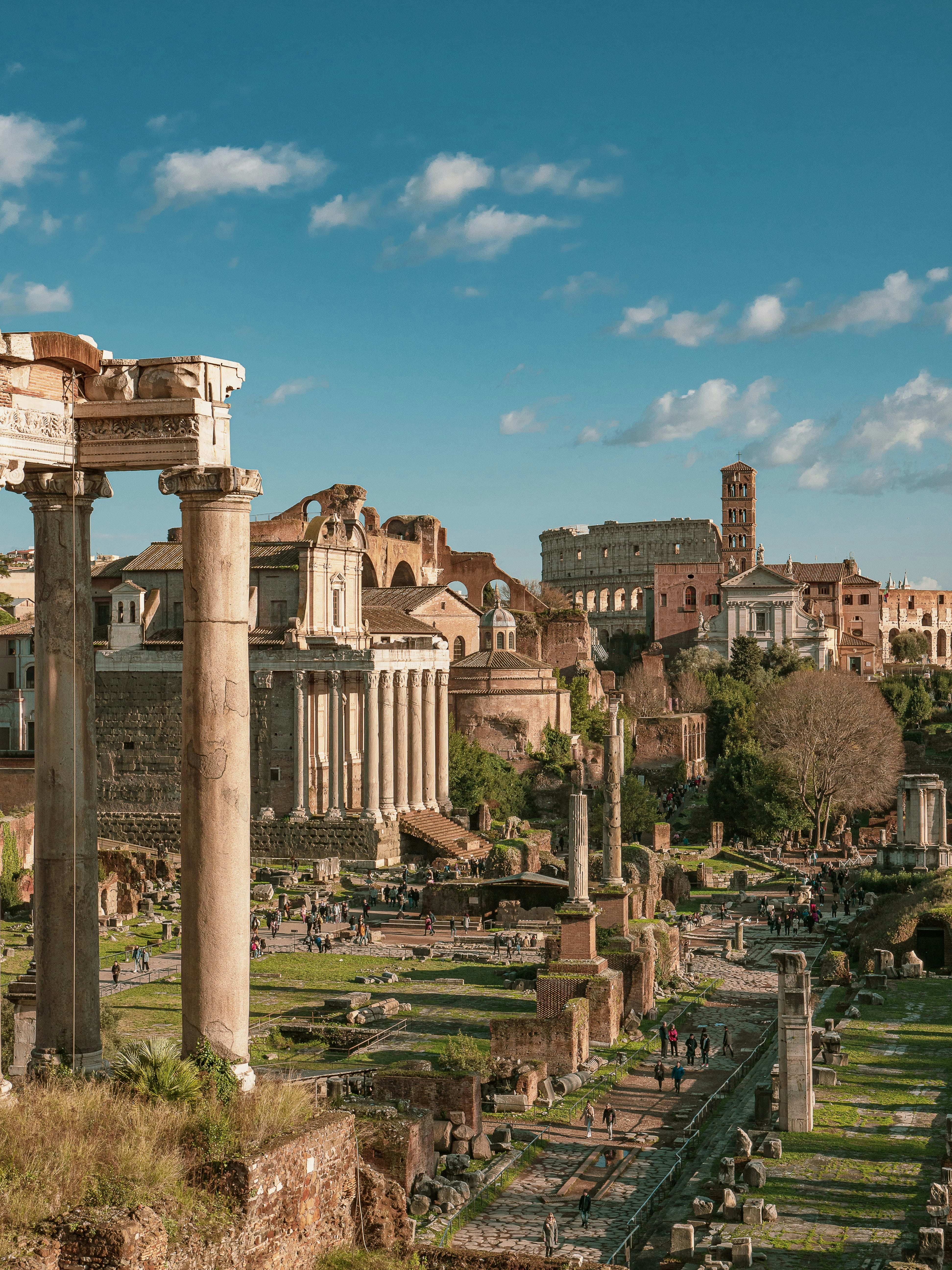
Once the political and social heart of ancient Rome, the Forum is a sweeping archaeological site of temples, basilicas and government buildings. Together with the adjoining Palatine Hill — traditionally where the city was founded — it forms a single archaeological area managed alongside the Colosseum, and a combined ticket covers all three.
The Capitoline Museums
On the Capitoline Hill above the Forum, the Capitoline Museums are among the oldest public museums in the world. The collection holds landmark works of ancient sculpture — including the bronze she-wolf that is a symbol of Rome — alongside paintings and Roman artefacts. The piazza in front, the Piazza del Campidoglio, was designed by Michelangelo, and the terraces offer sweeping views over the Forum below.
The Pantheon
One of the best-preserved buildings of ancient Rome, the Pantheon was built during the reign of Emperor Hadrian, around 118–125 AD, replacing an earlier temple commissioned by Marcus Agrippa, whose name still appears in the inscription across the façade. It remains the world's largest unreinforced concrete dome to this day. Its most famous feature is the oculus, the open circular opening at the centre of the dome. Now a functioning church, it stands within easy walking distance of the Trevi Fountain and Piazza Navona.
.jpg)
St. Peter's Basilica & the Vatican
In Vatican City, the world's smallest sovereign state, St. Peter's Basilica is one of the world's largest churches and the most renowned work of Renaissance architecture, housing Michelangelo's Pietà among its masterpieces. The adjacent Vatican Museums lead to the Sistine Chapel, with Michelangelo's ceiling frescoes. Dress is modest — shoulders and knees covered — as this is an active religious site.
Castel Sant'Angelo
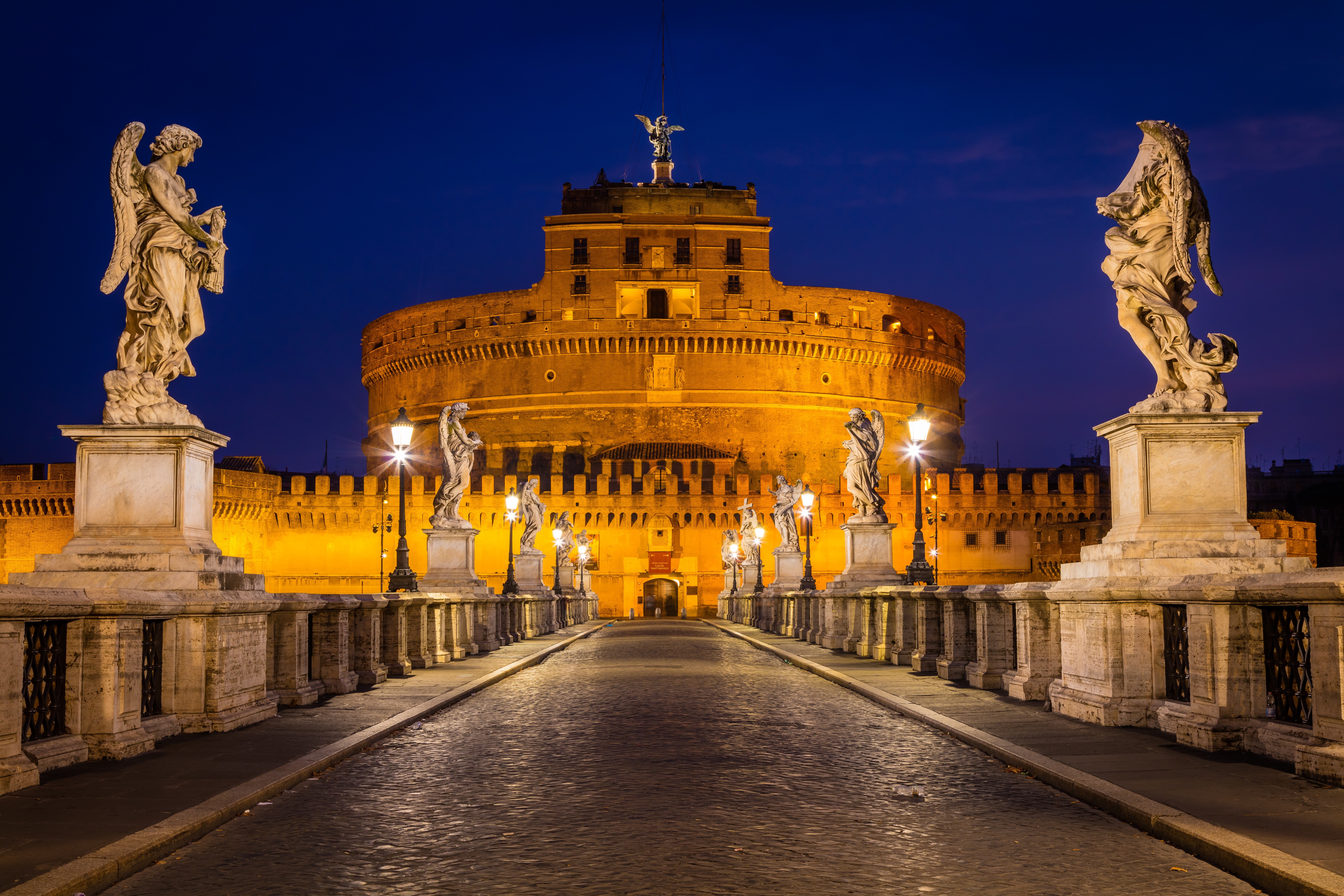
On the right bank of the Tiber, a short walk from the Vatican, Castel Sant'Angelo is a striking cylindrical fortress. Originally commissioned by Emperor Hadrian as a mausoleum for himself and his family, it was later adapted into a papal fortress, a prison and now a national museum. Its terraces give some of the finest views in the city, and it is reached across the statue-lined Ponte Sant'Angelo.
The Trevi Fountain
Rome's grandest Baroque fountain, the Trevi is the traditional spot to toss a coin over your left shoulder — legend says it guarantees a return to Rome. The fountain is free to admire from the surrounding piazza at any time. Since February 2026, reaching the basin at the water's edge — where the coin toss happens — requires a €2 ticket during daytime hours, with access free again after 10 p.m.; residents, children and disabled visitors are exempt. It is a short walk from the Pantheon and best seen early or late in the day, when the crowds thin.
Piazza Navona
Built on the site of the ancient Stadium of Domitian, Piazza Navona is Rome's most famous square — a striking example of Baroque architecture, home to two fountains, the centrepiece being Bernini's Fountain of the Four Rivers.
The Spanish Steps
A monumental staircase of 135 steps climbing from Piazza di Spagna to the Trinità dei Monti church at the top, the Spanish Steps were designed by Francesco de Sanctis in the 1720s. The name comes from the Piazza di Spagna, historically the site of the Spanish Embassy to the Holy See. At the foot sits the Barcaccia fountain by Pietro Bernini. Note that sitting on the steps is no longer permitted and the rule is enforced.
Beyond the centre
For those with more time, the Villa Borghese gardens and gallery, the Appian Way, and the Trastevere neighbourhood — with its narrow lanes and traditional trattorias — are all worth the detour.